
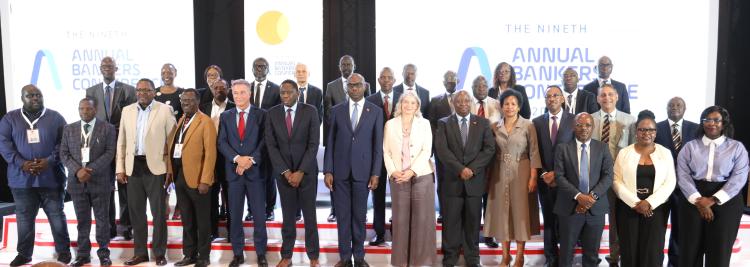
Musasizi Calls For Lower Lending Rates
Finance Minister, Henry Musasizi, has called on the banking sector to reduce lending rates and increase financing to productive sectors of the economy to support Uganda’s Tenfold Growth Agenda.
Speaking at the 9th Annual Bankers Conference held at Marriott Hotel, Nsambya, Kampala, Musasizi said Uganda’s ambition to grow its economy from US$50 billion in FY2025/26 to US$500 billion by 2040 must be matched by affordable and long-term financing.
“Government cannot deliver Uganda’s transformation alone. We need you. And, indeed, the banking and financial sector is central to the tenfold growth strategy,” Musasizi said.
The Minister urged banks to bring down the cost of credit, noting that average lending rates currently range between 18% and 20%. He encouraged financial institutions to improve credit assessment, make better use of data within the legal framework, and expand risk-sharing and guarantee mechanisms to reduce the risk premium on loans.
Musasizi also called for increased lending to the ATMS priority sectors (Agro-industrialisation, Tourism, Minerals including Oil and Gas, and Science, Technology and Innovation) rather than concentrating mainly on trade.
Agriculture contributes 26.2% of GDP but receives only around 12% of financial sector lending, while tourism receives less than 2% and minerals less than 3%.

He urged banks to work with the Capital Markets Authority to deepen long-term financing through infrastructure bonds, project bonds, green bonds and equity financing. Domestic market capitalisation stands at Shs 24.28 trillion, while assets under management have reached Shs 7.08 trillion.
The Minister further called for financial inclusion to be taken to scale, particularly for the 8 million farmers targeted for commercialization under the Parish Development Model (PDM), enabling them to save, borrow, insure, receive payments and invest.
He said private sector credit must rise from Shs 28 trillion today to Shs 490 trillion by 2040, while capital markets mobilisation must increase from Shs1.5 trillion to Shs 440 trillion.
Government, he added, will continue maintaining macroeconomic stability, pursuing financial sector reforms and working towards expanding Uganda Development Bank’s capitalisation to Sh2 trillion.
Musasizi invited the banking sector to sign the ATMS Financing Compact, which will establish measurable commitments on credit growth, pricing, productive sector lending and financial inclusion.
The conference brought together the banking and financial sector, regulators, development finance institutions, technology companies and development partners to discuss how Uganda can mobilise the capital required to achieve its long-term economic transformation agenda.
Uganda Bankers Association Chairperson and Housing Finance Bank Chief Executive Officer, Michael Mugabi, said the banking sector was ready to play its part in supporting the country’s journey towards a US$500 billion economy.
Mugabi noted that the ambition, anchored in the Fourth National Development Plan and the ATMS priority sectors, would require more than policy commitments. “As the banking sector, we hold the view that the economy does not grow 10-fold through policy developments alone,” Mugabi said.
He said economic growth occurs when capital finds productive opportunities, risks can be shared, businesses invest, and long-term savings are transformed into long-term investments.
He said bank credit alone could not deliver the scale of financing required, calling for greater use of equity finance, diaspora capital, new investment products, blended financing, impact funds, sustainability finance and risk-mitigation instruments.
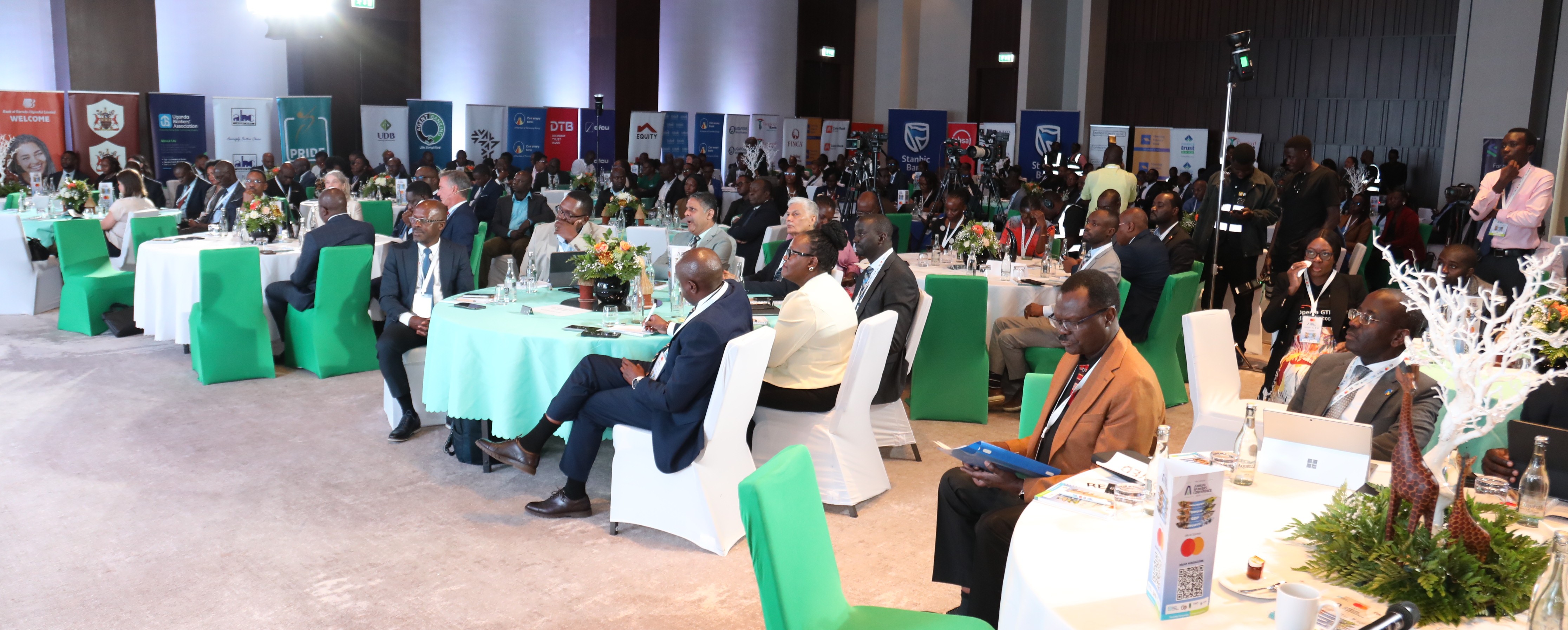
“Our industry plan clearly recognizes that banking sector credit alone cannot deliver the scale of financing required,” he said.
Mugabi urged participants to identify financing constraints, develop practical solutions and accelerate reforms that can unlock Uganda’s investment potential.
Bank of Uganda Governor Michael Atingi-Ego said Uganda’s transformation agenda must be supported by a financial system capable of mobilising resources and financing long-term investment.
Atingi-Ego said the country’s ambition to grow from a US$50 billion economy to US$500 billion by 2040 requires financial institutions to move beyond commitments and translate their plans into measurable action.
“The foundation is stability, which is the floor and not the ceiling,” he said.
Atingi-Ego identified agriculture, industrialisation, tourism, minerals including oil and gas, and science and technology innovation as areas requiring increased financing and specialised financial products.
He said agricultural transformation would require financing for food storage, value addition and export logistics across the value chain, while tourism needed investment in hospitality and transport infrastructure.
“Banks cannot and should not try to supply this capital single-handedly,” Atingi-Ego said.
He called for pension funds, insurance companies, development finance institutions and capital markets to complement banks in mobilising the capital required for Uganda’s transformation.
Atingi-Ego cautioned that credit expansion must be matched by growth in deposits, long-term funding and capital. “Every loan requires liability behind it. Every expansion of lending ultimately requires capital to support it,” he said.
Victor Ndlovu, Vice President and Head of Business Development, East Africa, at Mastercard, said Uganda’s Tenfold Growth Agenda presents a significant financing challenge requiring collaboration across the financial ecosystem.
Ndlovu highlighted digitalisation as a multiplier for financial inclusion and economic activity, noting that reducing reliance on cash has been linked to as much as a 1.5% contribution towards GDP growth in mobile-money countries like Uganda.
He highlighted Mastercard’s tourism initiatives, including the promotion of curated Ugandan experiences through its priceless platform, and Mastercard Move, which enables businesses and financial institutions to send and receive funds across more than 200 countries and territories.
Ndlovu said Mastercard had invested roughly US$12.6 billion in cybersecurity innovation since 2019, underscoring the importance of secure financial infrastructure.
He called for financial institutions to move from funding transactions to funding transformation, including long-term financing for mineral value addition, agro-processing and tourism infrastructure.
The Ambassador of the Kingdom of the Netherlands to Uganda, HE Angele Samura, reaffirmed the Netherlands’ commitment to supporting Uganda’s financial sector and agricultural development.
Samura said achieving Uganda’s growth vision would require a financial sector that is innovative, resilient and capable of mobilising capital towards the sectors driving long-term development.