
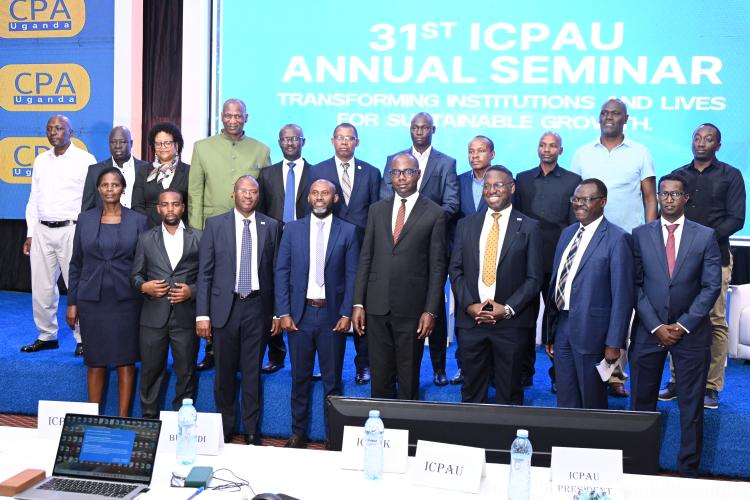
Musasizi Tasks Accountants on Fiscal Discipline, Accountability
The Minister of Finance, Planning and Economic Development, Henry Musasizi, has tasked accountants to play a stronger strategic role in strengthening fiscal discipline, accountability and evidence-based decision-making, saying the profession is critical to Uganda’s economic transformation.
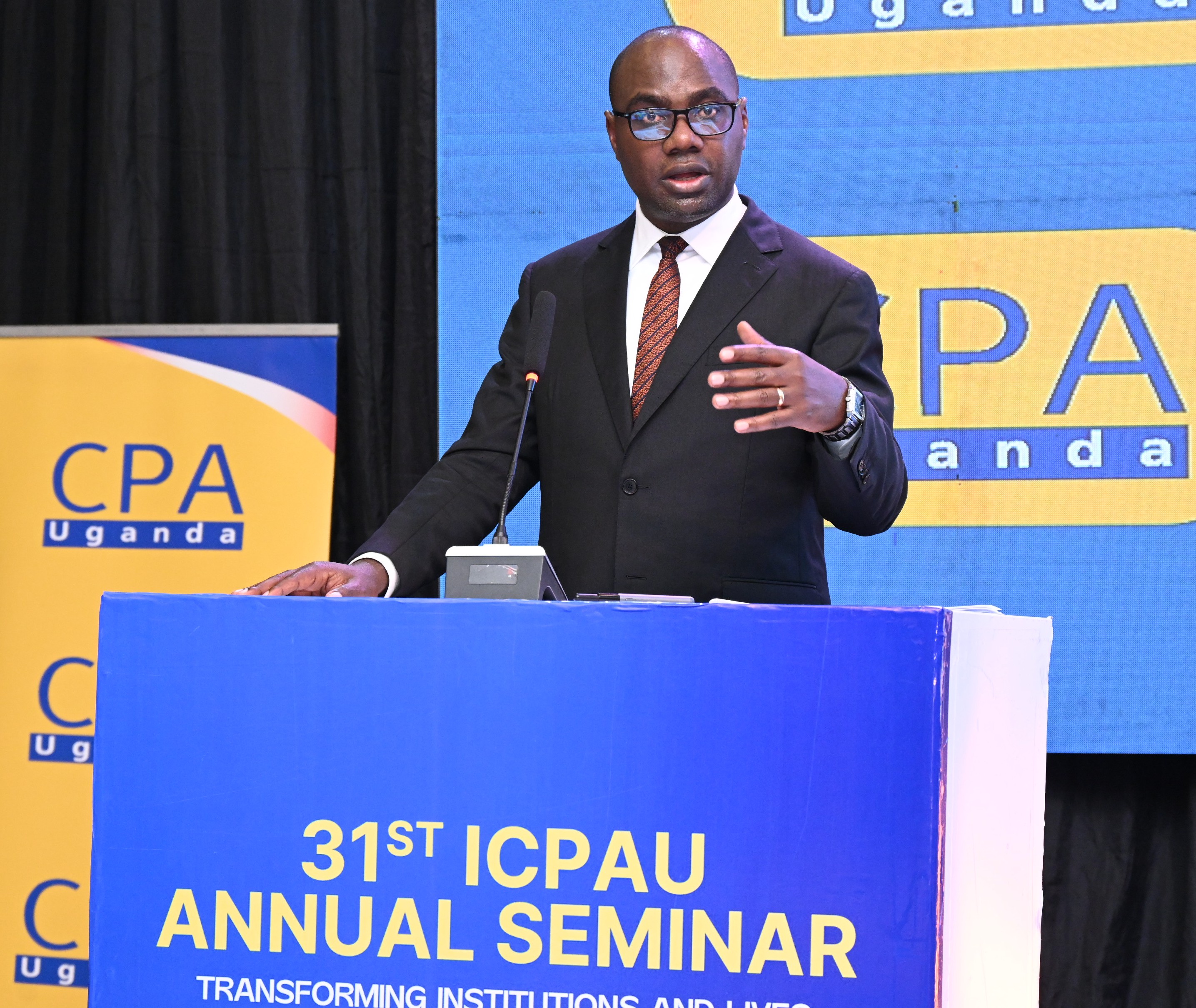
Musasizi made the call while officiating as Chief Guest at the 31st Annual Seminar of the Institute of Certified Public Accountants of Uganda (ICPAU) at Imperial Resort Beach Hotel, Entebbe, under the theme “Transforming Institutions and Lives for Sustainable Growth.”
The seminar brought together Accounting professionals, Government representatives, business leaders and other stakeholders for three days of reflection and professional development.
“Evidence-based decision making is fundamental to accelerating economic development, promoting sustainable business growth and avoiding costly policy and investment mistakes,” Musasizi said.
He noted that much of the evidence informing financial decisions is generated, analysed and validated through the accounting function, giving accountants a responsibility that goes beyond recording and reporting financial transactions.
The Minister said Accountants must increasingly provide insights that support better decisions, strengthen accountability and improve institutional performance. “Accountants are strategic partners in ensuring prudent fiscal management, effective public service delivery, and sustainable economic development.”
In the public sector, Musasizi said reliable financial information enables Government to track revenues and expenditures, safeguard public assets, manage liabilities and assess whether public resources are translating into intended development results.
He highlighted the role of Accountants across the three stages of the national budget: planning and budget preparation, budget execution and control, and budget accountability and reporting.
During budget execution, he said Accountants help track public resources, monitor cash flow and spending limits, and track financial commitments before payments occur, helping to prevent domestic arrears and large fiscal deficits.
Musasizi also linked the profession to Uganda’s Tenfold Growth Strategy, which seeks to expand the size of the economy to US$500 billion by 2040, with resources targeted towards Agro-industrialisation, Tourism, Mineral development, Science and Innovation (ATMS) and their critical enablers.
The strategy is expected to drive structural transformation through exports and jobs, increase productivity and business competitiveness, create employment and improve the quality of life of Ugandans.
“Regular assessment of progress is key in realisation and inevitably accountants will play a very crucial role in this regard,” Musasizi said.

He further called for continued attention to Uganda’s economic fundamentals, including economic growth averaging over 6% per year, low inflation averaging about 3.5% in recent years, a stable and tradeable shilling, good infrastructure and positive business confidence.
To improve budget outcomes, Musasizi said Government is implementing reforms including Electronic Government Procurement, strengthening fiscal discipline and accountability, and improving project implementation readiness to enhance return on investment.
He urged Accountants to support these reforms while also adapting to technological changes transforming the profession. “As the world moves towards greater digitalisation, accountants must embrace technology and innovation,” he said, pointing to digital financial management systems, blockchain, artificial intelligence and other emerging technologies.
Technology must not replace integrity
ICPAU President CPA David Timothy Ediomu said the changing environment requires accountants to expand their skills beyond traditional financial functions.
He said artificial intelligence is changing how work is performed, digital transformation is changing how businesses operate, while sustainability considerations and increasingly sophisticated financial crime are creating new demands on professionals.
“The Accountant of the future must be able to interpret information, understand technology, manage risk, communicate effectively, think strategically and provide trusted advice,” Ediomu said.
He, however, stressed that technological advancement must go hand in hand with ethics and public interest. “Technology can make us faster. Integrity is what makes us trustworthy,” Ediomu said, arguing that artificial intelligence can process information, identify patterns and automate tasks, but cannot replace the professional responsibility of making ethical decisions with empathy.
Ediomu described Accountants as “guardians of trust” because they prepare and provide information on which important decisions are based, support businesses, advise organisations and contribute to public financial management.
He said ICPAU will continue to emphasise competence, professional standards, ethical conduct and continuous professional development. He also urged the profession to contribute more deliberately to Uganda’s development agenda through high-quality financial reporting, good governance and accountability.
“Uganda's economic progress depends not only on the policies we formulate, but also on the quality of the institutions and professionals responsible for implementing those policies,” he said.
Ediomu highlighted new global standards adopted by ICPAU, including the International Standard on Auditing for Audits of Financial Statements for Less Complex Entities (ISA for LCEs), IFRS S1 and S2 Sustainability Disclosure Standards, and the Global Internal Audit Standards.
He said the standards are intended to improve transparency, strengthen governance, build investor confidence and make Ugandan businesses more competitive globally.
Accountants must become strategic partners
ICPAU Secretary/Chief Executive Officer CPA Derick Nkajja said the profession is operating in an environment marked by rapid technological change, evolving business models, economic uncertainty and heightened expectations for transparency and accountability.
He said Accountants must therefore extend their contribution beyond traditional financial reporting, compliance and stewardship. “We are uniquely positioned to shape decisions, strengthen institutions, safeguard trust, allocate resources responsibly and influence the quality of lives and communities we serve.”
He said the seminar provides an opportunity for professionals to examine how their knowledge, ethical leadership and personal influence can contribute to transforming institutions and lives.
Nkajja also emphasised the importance of developing competent, ethical and adaptable professionals capable of leading in a rapidly changing environment.
The seminar, he said, should not be viewed simply as an opportunity to acquire knowledge but as a platform for dialogue, collaboration, challenge and action. “What must we do differently today to create institutions and lives that will thrive tomorrow?” he asked participants.
Government reaffirms support to ICPAU
Musasizi pledged Government’s readiness to strengthen its partnership with ICPAU in developing the profession, particularly in emerging areas.
He also reaffirmed the Ministry’s commitment to supporting ICPAU’s new home in Bukoto, recalling that he had officiated at the groundbreaking ceremony and pledged Ministry support towards furnishing the facility.
The Minister urged participants to go beyond identifying challenges and focus on practical solutions that can accelerate Uganda’s socio-economic transformation. He reiterated Government’s commitment to strengthening institutions, improving public finance management and accountability, and creating an enabling environment for sustainable and inclusive economic growth.
The seminar also carries a personal significance for Musasizi, who has a background in accounting. He said the profession played a defining role in his journey from an Accountant to Member of Parliament, Chair of Parliamentary Committees and ultimately Minister of Finance.